Showing posts with label #4TH GRADE. Show all posts

Monday, August 22, 2022

FREE MISC. LESSON - “Study Teams Supreme”

by Class around the Corner
3rd - 12th Grade 
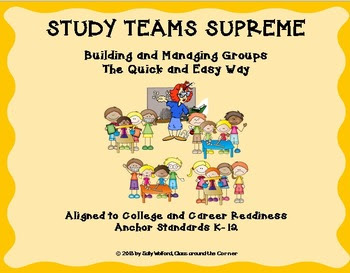

Building and Managing Groups the Quick and Easy Way

A sociogram is a quick and easy way to get to know how your kids see each other socially in the classroom. It is an excellent tool to use for building cooperative groups and/or collaborative teams.

Let me tell you a story:

My best memory of using a sociogram was with a very diverse group of fifth graders. They had cultural and ethnic lines already established when I introduced “groups,” based on sociogram data. Some verbally complained; two said they absolutely wouldn’t participate; others remained silent; only three seemed happy about it. I simplified the first few tasks that dealt basically with talking to each other about a subject. I reminded them that they didn’t have to like each other; they weren’t stuck with each other for the whole day or for a lifetime. I added incentives for being positive about “trying”. The barriers slowly were torn down, the lines diminished, friendships formed, and collaboration was born. Over the years I have run into these students, who are now finishing high school, and they speak so happily about that year together. It enriched my life for sure!

CCSS: College and Career Readiness Anchor Standards for Speaking and Listening (K-12):

CCSS.ELA-LITERACY. CCRA.SL.1
CCSS.ELA-LITERACY.CCRA.SL.2
CCSS.ELA-LITERACY.CCRA.SL.3
LACC.SL.1.3

You will be Surprised!

It may surprise you to see that students you thought were the most popular are ones who are not first-choice by classmates when selecting study team co-workers. Sometimes students whom you think are not sought out socially are the ones classmates choose to work with in an academic setting.

By building study teams based on sociogram data, you will see kids who hesitate to cross ethnic or cultural boundaries begin to make genuine change in social attitudes.

See Lasting Relationships that Cross “Boundaries”.

See your students build lasting relationships that cross social and academic settings. They will learn to value one another as partners and as friends. I’ve loved seeing that happen in my diverse classrooms over the years.

Take a look at our other products at http://www.teacherspayteachers.com/Store/Class-Around-The-Corner. Thank you for your attention.

https://www.teacherspayteachers.com/Product/Study-Teams-Supreme-846136


Join The Best of Teacher Entrepreneurs Marketing Cooperative at
https://thebestofteacherentrepreneursmarketingcooperative.net/the-best-of-teacher-entrepreneurs-marketing-cooperative-one-year-membership/
and get THOUSANDS OF PAGE VIEWS for your TpT products!


Go to http://www.pinterest.com/TheBestofTPT/ for even more free products!


Saturday, February 29, 2020

Vincent Van Gogh, Constellations & Coordinate Graphs: A Math & Literacy Project


Sometimes, our students give us the best ideas. We were mucking through our solar system unit in science, reading about how the night sky is charted, when Charlie said, "This kind of reminds me of how we graph points."

I love moments like this. It's like everything kind of slows down, and our brains begin to connect the dots (no pun intended). Charlie's response was the catalyst for this project. To this day, he likes to say that he added the spice to our fifth grade coordinate graphing unit. And he would be right. 

I went home that night and began to pull resources together for a multi-disciplinary project. There was one Common Core State Standard that had been causing grief...


5.G.A.2 Graph points on the coordinate plane to solve real-world and mathematical problems. 


It was the "real world" part that perplexed me. The next week, we got down to business. We began by reading about Vincent Van Gogh. I chose this artist because "Starry Night" is a painting that most students recognize, and I wanted to bring our study of constellations into the math class. I found two children's books that did a nice job.
In Katie and the Starry Night, a young girls visits famous paintings. When she view's Van Gogh's "Starry Night," the stars come tumbling out of the painting. She experiences the painting as she attempts to round up the rogue stars.

In Vincent Can't Sleep, readers experience the night sky through Vincent's sleepless eyes. This book explores how Vincent's lifelong insomnia provided inspiration for one of his greatest works. 

In addition, we read a straight biographical sketch that I wrote about Van Gogh. 
After reading the books, biography and a quotation biography that I created for my students, students responded to the readings by using the Step Inside thinking routine. You can read more about that here.

We also spent some time observing "Starry Night" up close and personal using our SMART board, so it would be projected big enough for us to notice small details. 

Later on in the week, we researched different constellations. We extended our science learning a bit and read about some of the myths associated with the constellations. I created constellation cards for my students to use. I also curated a list of websites about constellations and uploaded them in our Google Classroom site. 

Finally, we were ready to begin reviewing our coordinate graphing concepts. We practice graphing X and Y coordinate data and applying increase and decrease rules to that data. Students accepted a commission from a wealthy patron who wanted a night sky with one constellation picture created for her home. It must be inspired by Vincent Van Gogh's "Starry Night."  My kids chose a favorite constellation and graphed it on a small coordinate grid. They recorded the coordinates for their constellations. 

Then, real life came traipsing in all over their artistic dreams. The wealthy patron wrote them a letter explaining that she wanted the picture to be double the size. It had to be larger. At this point in the project, students demonstrated that they could write a mathematical rule for their X and Y coordinates, apply it, and graph them to create an art piece double the size of the original. 

After doing this, they used oil pastels to create their art piece inspired by Vincent Van Gogh. Then, they cut out an horizon scape that I had printed on 11"X 17" paper. They traced these on black construction paper and glued them to the bottom part of their night skies. This made their art look similar to Van Gogh's. Instead of painting a village scape, they used black construction paper cities, forests, lighthouses, etc. for a silhouetted effect. 

The last step of this project was a student learning statement in which I required my students to reflect on what they learned about coordinate graphing, rules, constellations and Vincent Van Gogh.  

What I absolutely love about this project is that I could combine some really rigorous literacy goals with science concepts and equally challenging math goals. And my students were ON FIRE with enthusiasm and engagement. Charlie actually said, "This has something for everyone, Ms. Willis!" And again, he would be right. 

You can find the Starry Night project by clicking on the picture below!

And if you like multi-disciplinary projects like this one, you have to check out the ones below! They will rock your classroom world!


Wednesday, February 13, 2019

Student Voice & A Love of Learning


I sent my neighborhood minions out to gather paying customers for our newly practiced theater production. We had worked all morning in the hot summer sun, and now, clothed in the splendor that was my mother's old bridesmaid gowns and cast-off Halloween costumes, we were ready to perform. The lawn chairs were set up, the sidewalk stage waited, our breezeway was our backstage area. 

You could watch the next award-winning Broadway production for a quarter. Another quarter would get you some Country Time Lemonade while you watched. Afterward, we would sign autographs on the red carpet, my mother's Christmas tablecloth that I had stolen from the bottom of the china cabinet.

Looking back, I think I always had a voice. Whether I was writing plays and directing, crafting poems for our small town newspaper, or mouthing off to my mom and then writing furiously in my diary about her unfairness, I had a voice. I have my childhood report cards to prove it... "Tracy needs to curb her talking."

VOICE. 

As a teacher, one of the surest way to lead my students to love learning is to honor their voices, their thinking, their opinions, and their stories. When I make their voices the center of the learning opportunity, great things happen. 

Every year in March, my students and I hold an election. We review the major mentor texts that we read over the entire school year. We discuss them. We share our opinions about our favorites and our least favorites.  Then, we vote to elect our Book-of-the-Year for room 13. 

My students create a huge mind map about all ten of our mentor texts. They draw arrows to and from text titles to show connections they find between the texts. By doing this, my kiddos are remembering what we've read. They're reengaging with the books. They sit on the floor, surrounding the butcher paper, discussing characters and themes. They begin to find connections between the texts. This delights me, because many of the connections aren't intentional, and yet they can see common threads.


Afterward I ask students to choose one mentor text that they wanted to nominate for our Book-of-the-Year Award. Surprisingly, every book is chosen by at least one student.  They return to their seats to do a flash write about their choices. Because they are invested in sharing their opinions about something they care about, they write their literary essays with zest. They know they have to sell their book choice in order for it to win. 


We study bias in text and discuss how authors use words in certain ways to convince or rile up their readers around a product or cause. My students use these techniques while writing about their book nominations.


After drafting, revising and editing, they practice their nomination speeches at school and home. Finally the red carpet day has arrived. They come to school dressed in their best red carpet attire. Students who don't want to wear their finery to school have photo booth props that they've made. They use these instead. I lay out the plastic red tablecloth I bought at the local dollar store. Each student holds their nominated book, struts down the carpet and stands in front of a podium to give his or her persuasive speech (literary essay) to the class. Afterward we vote, and the winner is declared. My students LOVE this, even my hard-to-motivate student who struggled to finish any writing assignment the entire year. 

When we honor our students' voices, great things happen...every time.


The one thing that you have that nobody else has is you. Your voice, your mind, your story, your vision. So write and draw, and build and play, and dance and live as only you can.
                                            -Neil Gaiman 

If you're interested in learning more about this project, click on the picture. 


Be sure to visit these fabulous educators below! There are a wealth of ideas here that are sure to ignite a love of learning in your kiddos!


Spark a Love of Learning with Games  | The Owl Teacher       

Spark a Love of Social Studies  | Tried and True Teaching Tools     


5 Ways to Ignite a Love of Math Problem Solving | Think Grow Giggle          


Valuing Student Voice to Create a Love of Learning | Wild Child’s Mossy Oak Musings


Friday, February 1, 2019

Love Letters & Brussel Sprouts: Odes, Point-of-View and Visible Thinking


You're my funny valentine, sweet comic valentine

You make me smile with my heart

Your looks are laughable, unphotographable
Yet, you're my favorite work of art.
-Rodgers & Hart


Growing up, I never crushed on the cutie patooties or the hottie patotties.  I fell for the guys who could make me laugh hysterically or make me swoon by reciting poetry.  So, it's only natural that as a teacher, the valentine books I love the most incorporate poetry and humor.  That's what led me to Love Letters by Arnold Adoff.  This book is comprised of funny, touching, and yet untraditional love letters written as poems and odes.  The letters are addressed to teachers, classmates, family members, or to"fill-in-your-own-name," which is the perfect poem for those people who have a harem of admirers.  The poems in this book stand independently and could be shared one at a time over the course of a couple of weeks. 
Adoff uses fantastic imagery that any child can relate to,  "I love you more than peanut butter cookies crumble. I  love you more than yellow bees bumble. I also love you more than dark thunder clouds rumble..."  These lines are from the poem entitle "Dear Tall Girl at the Front Table," one of my favorites in the book.

Every year, I share this book with my students.  My fourth and fifth graders love it and "get" the humor in it. I use it to introduce odes and anti-odes. We brainstorm a list of ideas for our own odes, for example: A  pet dog, cat, guinea pig, etc., pepperoni pizza, mom's lasagna, brussel sprouts, broccoli, piano, hockey stick, soccer ball, x-box, play station, Legos, teddy bear, favorite book, favorite book character, etc. 

After we've made our collaborative list, they choose a few of the topics that grab them, and sort them into the categories "things I love," and "things I hate. Once they've done this type of thinking, they zoom in one topic and dig deeper into their feelings about the topic. Here's an example:

Then they explore point-of-view. In Love Letters, the poems are sometimes companion poems that explore different view points. So if I'm writing about brussel sprouts, I write about own point-of-view and how much I loathe them. And then, if the brussel sprouts were to write a letter back to me, what would they say? As a poet, I explore both viewpoints.

Finally, my students begin their rough drafts. We spend about two sessions drafting and revising. I make sure to include a mini-lesson about line breaks, because fourth and fifth grade students still tend to write poetry in paragraph form. We do a lot of reading aloud to ourselves using our whisper phones. By the way, this is AWESOME fluency practice! I teach my kiddos that poetry is actually an art form that is meant to be read aloud. So when they choose to read poetry books or their own poems during independent reading time, I let them go hog wild with whisper phones. 

I should add that I model each pre-writing, drafting and revision step for my students. Here are two examples of poems that I wrote with them in order to model the process:


 Dear Macaroni and Cheese,
I looooove your cheesy goodness.
I am overwhelmed by your
bubbling orangeiness.
I love you more than a dog
loves its bone,
more than a baby
loves its bottle.
Your crispy cracker crumbs,
golden like the summer sun,
send me over the moon.
I will love you forever.
Love,
Your Hungry Fan

(By Ms. Willis)
My students identify comparative statements (simile-like), personification, alliteration, and descriptive language as I write and we discuss.  Then, I model an anti-ode.  You can also see it below:
  
Dear Brussel Sprouts,
I loathe your army-green leafy heads
wrapped tightly on my dinner plate.
No bacon or butter
can disguise your nastiness,
your cruciferous metallic taste.
You look like mutant baby heads.
And on dark and lonely nights,
you hold me hostage
at the supper table,
long after the dishes have been done,
and the kitchen
has been cleaned.
 Signed with disgust,
I'll-eat-any-other-vegetable-other-than-you Girl

After students have published their poems on the special valentine stationery I provide for them, we use an envelope template and make envelopes for our poems. They address the envelopes. They put their published poems in their envelopes, and we display them for everyone to read.

Valentine's Day can be a tricky holiday in upper elementary. Hormones have begun to rage, friendships are precariously navigated, and feeling are easily hurt. This project is one of my students' favorites, year after year. It's funny, creative, and non-threatening (and Common Core aligned)!

To learn more about using it in your own classroom, simply click on the picture.

If you're looking for more upper elementary valentine resources, you might also check these out. Two of them are free!


https://www.teacherspayteachers.com/Store/Wild-Child-Designs


Friday, January 4, 2019

Zooming In to Read With Wonder


Criss-cross applesauce. That's how I was sitting on the floor of the kindergarten classroom. I had scrunched my 40-something year old self into a pretzel so I could watch kindergartners with chocolate milk mustaches and grass-stained knees eyeball goldfish in science class aquariums. The excitement was palpable.

"Whooaaaaa! Look at that one!"
"He's fast!"
"Can I name mine Stella?"
"I'm gonna name mine Batman!"

Then the scientists got down to business. They whipped out pencils and orange, yellow, black and white crayons. They drew what they saw. They drew arrows to label fins, eyes, gills and tails. Riveted, their kindergarten eyes were glued to every movement in their aquariums. 

The room was filled with wonder, and for a brief moment, I thought about moving from fifth grade to kindergarten. 

I quickly got over my lapse of reason. Teaching upper elementary is my happy place, but the seductive glory of kindergarten wonder and astonishment turned my head. I ambled back to my own classroom thinking about the importance of wonder in learning and teaching. 


As a dinosaur in the teaching world (I prefer to think of myself as an armored triceratops), I've noticed a trend in my readers. My students gravitate toward what I call "hot fudge sundae books." They read the trifecta: Wimpy kids,  underpants, the Disney-endorsed fiction. Don't get me wrong. I love the fact that they are reading, but my heart longs for them to independently experience books on a deeper level...books that stay with them like a fabulous meal at a five-star restaurant...books that make them wonder about the world.

That's how I talk to them about reading. They need a balanced diet. I go into the whole nutritional reading metaphor and talk about how dessert books only fill your mind up to a certain point, and then you're hungry again. That approach works, but only on a short-term basis. So I decided I had to do some marketing. 


First Chapter Fridays & Visible Thinking

Taking a page from Ron Ritchart's Making Thinking Visible, I massaged the Zoom In thinking routine, and added a dash of the See-Think-Wonder routine. 

Every Friday, I bring three chapter books from my classroom library to our meeting area. I facilitate a see-think-wonder about the covers of each book. 
What do you see? What do you notice on the cover?
What do you think about what you notice?
What are you wondering about?
Then I read the first chapter of the first book. I stop about 3 to 4 times as I read through the chapter so students can zoom in. The zoom-in thinking routine is usually used with visuals. It allows students to view an image in small chunks.  I modified this routine and used it with text. Students were allowed to see/hear small sections of the first chapter, until the whole chapter was revealed. At each stopping point, I ask students to stop and jot their noticings, thoughts, and questions. At the end of the first chapter, they stand up and walk and talk with a thinking partner about the chapter they just heard. 


Then I do it again with the second and third books I choose. By the end of the session, they are jockeying in line to get those books, so much so, that we have created wait lists for our First Chapter Friday books.

It's funny how simple some solutions can be, isn't it? As a result of our see-think-wonder, zoom-in routines and First Chapter Fridays, my students are branching out as a readers and thinkers. They're discovering new worlds, and I couldn't be happier. 
There are worlds within worlds...Everything in our world is connected by the delicate strands of the web of life..."
                                                                                      -"Ferngully"

Want to explore some visible thinking routines in your classroom? Do your students read a balanced diet? Check out these resources! They could make a difference for your kiddos, as they did mine!


I'm so lucky and privileged to be part of a phenomenal group of upper elementary bloggers. You won't want to miss out on their posts about wonder and curiosity this month! Visit them below!


Saturday, March 31, 2018

Geometry- Types of Triangles Task Cards

Geometry- Types of Triangles Task Cards

 Geometry- Types of Triangles Task Cards

This is a colorful set of 24 task cards that will help students identify the main types of triangles: Isosceles, Scalene, Right, and Equilateral.This set is a wonderful addition to your lessons! I

***This set is also available at 15% off in the Geometry Mega Bundle! Here's the link to the bundle:Geometry Mega Bundle

I've included a recording sheet and answer key, too!

◈◈◈◈◈◈◈◈◈◈◈◈◈◈◈◈◈◈◈◈◈◈◈◈◈◈◈◈◈◈◈◈◈◈◈◈◈◈◈◈◈◈◈
These activities would work for grades 1-4! 
◈◈◈◈◈◈◈◈◈◈◈◈◈◈◈◈◈◈◈◈◈◈◈◈◈◈◈◈◈◈◈◈◈◈◈◈◈◈◈◈◈◈◈

Here are some possible uses for these in your classroom:

✿ early finishers
✿ tutoring
✿ sub tubs
✿ math stations/centers
✿ holiday work
✿ small group
✿ end of unit quick assessments 
✿ homework
✿ reinforcement
✿ enrichment

◈◈◈◈◈◈◈◈◈◈◈◈◈◈◈◈◈◈◈◈◈◈◈◈◈◈◈◈◈◈◈◈◈◈◈◈◈◈◈◈◈◈◈
★★★What teachers are saying about this resource:

✎"Awesome Resource" Stephanie R.

✎"Geometry made simple...." Keri S.

◈◈◈◈◈◈◈◈◈◈◈◈◈◈◈◈◈◈◈◈◈◈◈◈◈◈◈◈◈◈◈◈◈◈◈◈◈◈◈◈◈◈◈
Here are some other math resources you might to check out: 

3rd Grade Daily Math COMPLETE BUNDLE

Geometry-Symmetry Task Cards

Measurement-Correct unit of measure

Measurement-ounces and pounds

Telling Time Task Cards nearest 5 minutes

Telling Time Practice-24 PAGES! NO Prep!

Word Problem Task Cards -Set A

Word Problem Task Cards -Set B

◈◈◈◈◈◈◈◈◈◈◈◈◈◈◈◈◈◈◈◈◈◈◈◈◈◈◈◈◈◈◈◈◈◈◈◈◈◈◈◈◈◈◈
Customer Tips: 

How to get TPT credit to use on FUTURE purchases: 

❤Please go to your My Purchases page (you may need to login). Beside each purchase you'll see a Provide Feedback button. Simply click it and you will be taken to a page where you can give a quick rating and leave a short comment for the product.

❤Each time you give feedback, TPT gives you feedback credits that you use to lower the cost of your future purchases. 

❤I VALUE your feedback greatly as it helps me determine which products are most valuable for your classroom so I can create more for you. 
Be the first to know about my new discounts, freebies and product launches. All new resources are 50% off the FIRST 48 hours!

❤Look for the green star next to my store logo and click it to become a follower. Voila! You will now receive email updates about this store. 

◈◈◈◈◈◈◈◈◈◈◈◈◈◈◈◈◈◈◈◈◈◈◈◈◈◈◈◈◈◈◈◈◈◈◈◈◈◈◈◈◈◈◈

My TPT store:❤ Believe to Achieve Store by Anne Rozell

Follow my Pinterest boards:❤My Pinterest Boards

Follow me on Facebook:❤ My Facebook

Follow me on Instagram:❤ 
My Instagram

Follow me on my blog: ❤ My Blog
◈◈◈◈◈◈◈◈◈◈◈◈◈◈◈◈◈◈◈◈◈◈◈◈◈◈◈◈◈◈◈◈◈◈◈◈◈◈◈◈◈◈◈


Join The Best of Teacher Entrepreneurs Marketing Cooperative at
http://www.thebestofteacherentrepreneursmarketingcooperative.com/2014/01/the-best-of-teacher-entrepreneurs.html
and get THOUSANDS OF PAGE VIEWS for your TpT products!
Victoria Leon's TpT Store


Go to http://www.pinterest.com/TheBestofTPT/ for even more free products!